Sky Trax Industries · Aircraft Conceptual Design 2026
Ultra-Long-Range Intelligent VIP Transport
"Fly Further. Know More. Land Safer."
Executive Overview
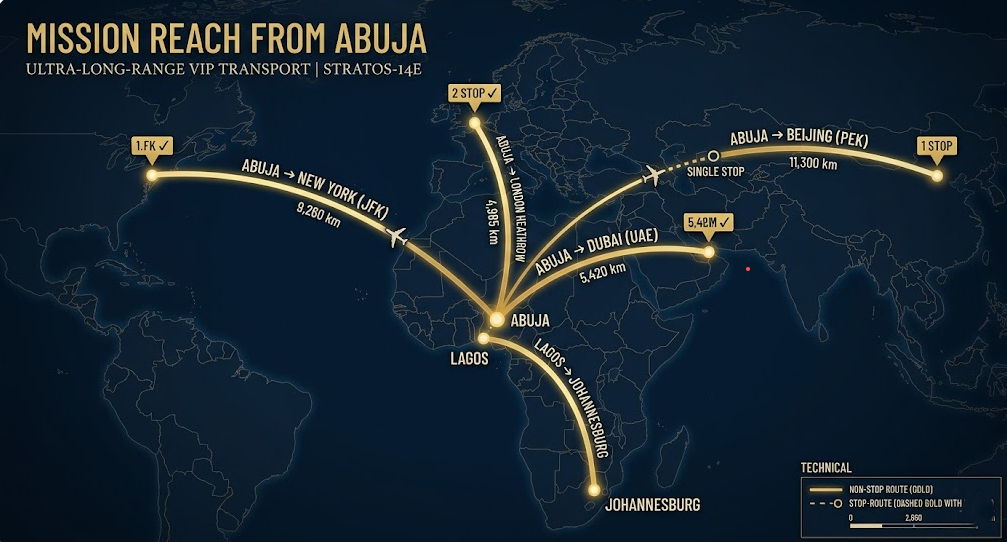
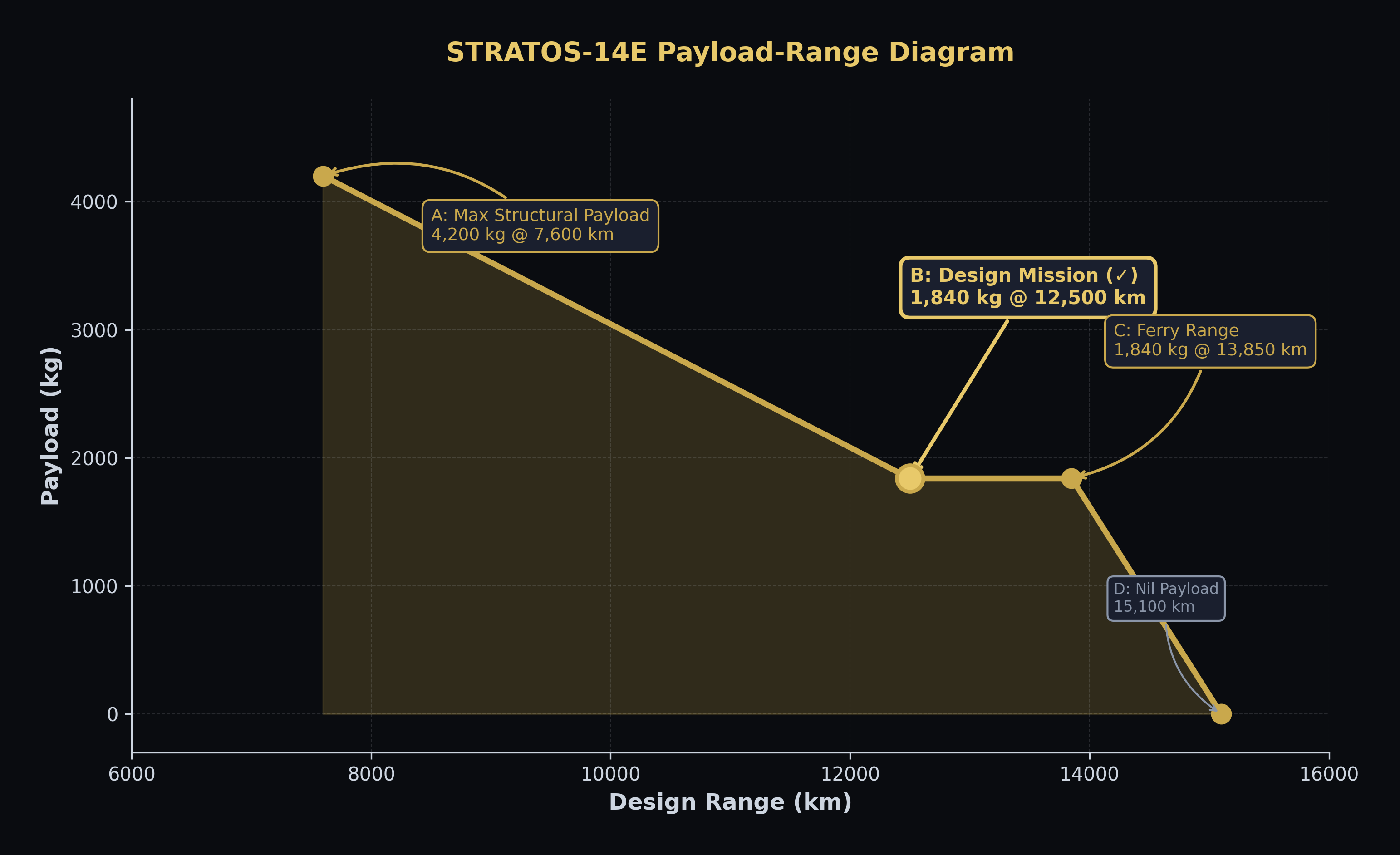
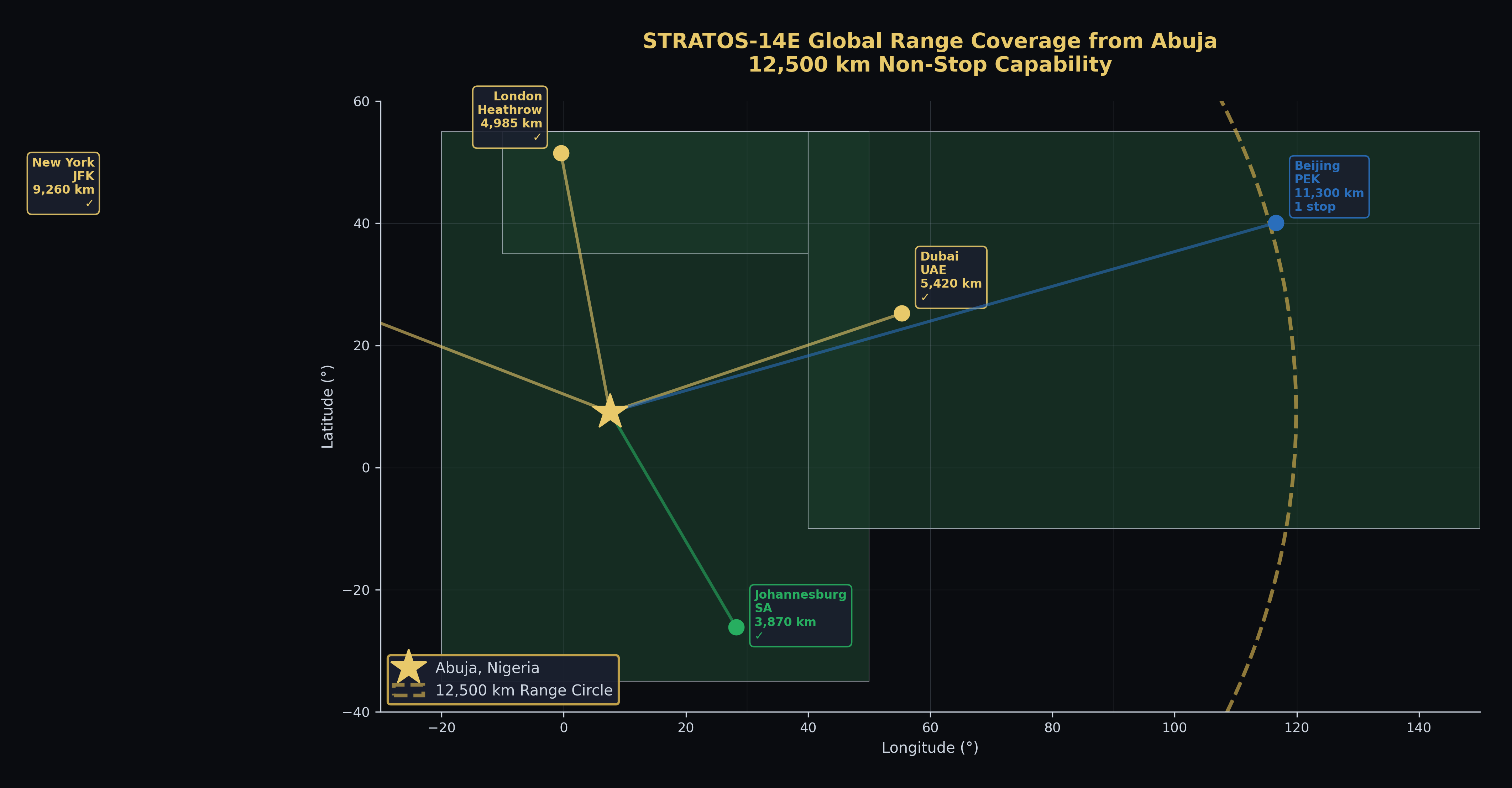
The STRATOS–14E is a twin-engine ultra-long-range VIP transport engineered for the demands of heads of state, sovereign operators, and the global executive segment. Developed by Sky Trax Industries in response to Nigeria's national executive transport requirement, it achieves 12,500 km at Mach 0.85 — connecting Abuja to London, Dubai, or Beijing without a single refuelling stop.
Unlike competitors built for Western infrastructure, the STRATOS–14E was designed from the ground up for global reality: hot-and-high airports, limited maintenance ecosystems, and the evolving sustainability mandates of ICAO CORSIA. It is not a repositioned Western product. It is the first purpose-built sovereign transport for Africa and the developing world.
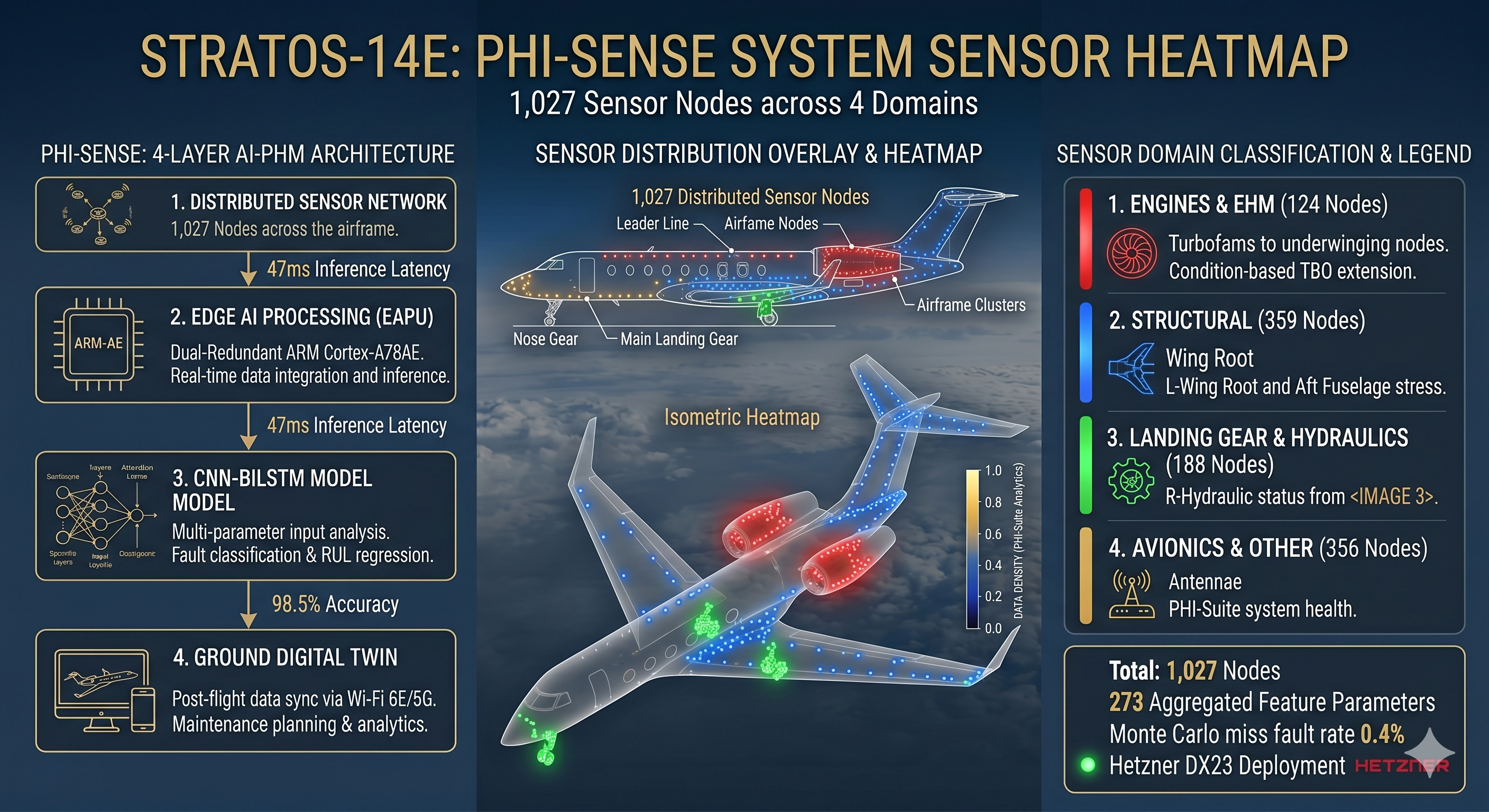
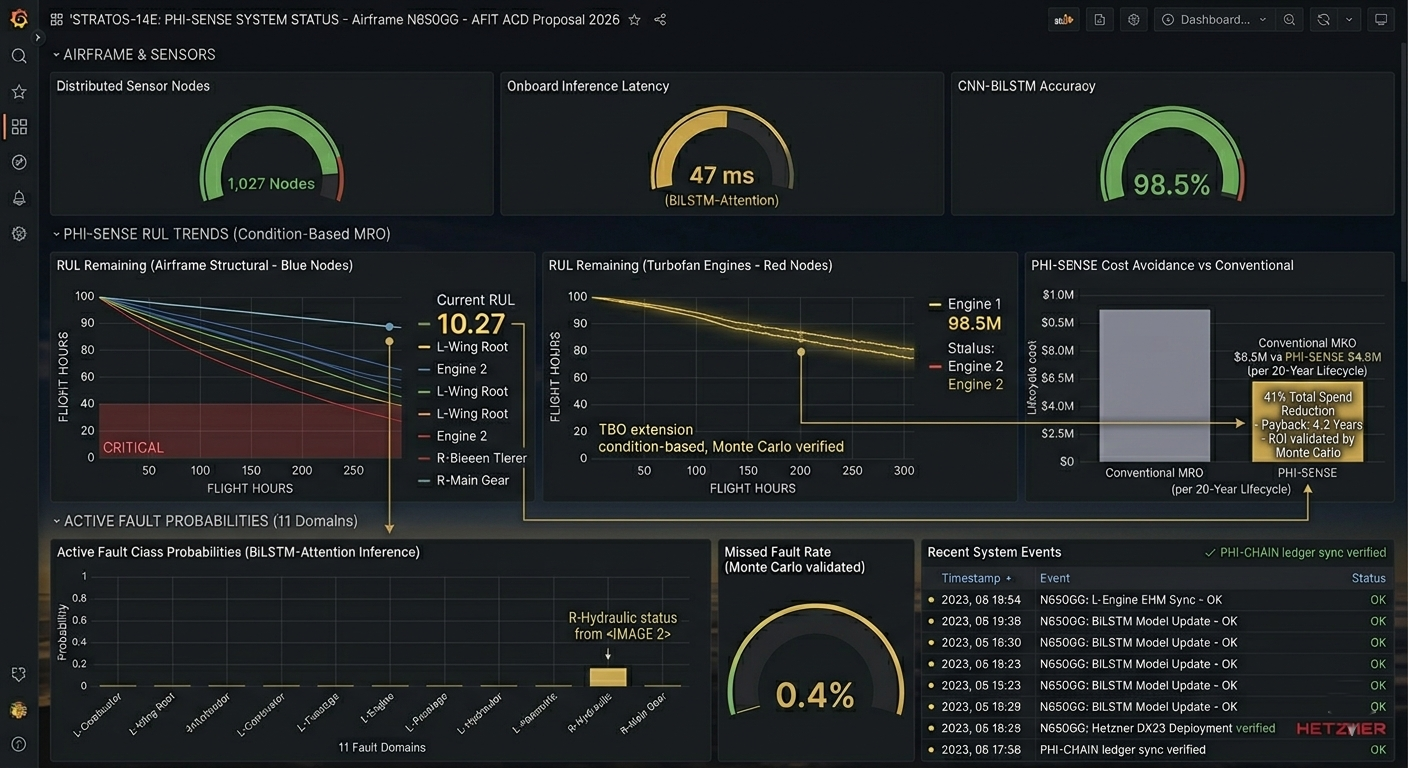
Its defining competitive advantage — PHI-SENSE — is the world's first AI-native health monitoring architecture embedded at the conceptual design stage, not retrofitted. 1,027 sensors. 47 ms inference. 42% fewer groundings.
Four Design Pillars
12,500 km at full payload — no compromise on range vs. passenger trade-off that competitors quietly apply.
1,640 m balanced field length enables access to secondary airports unavailable to competing aircraft in this class.
PHI-SENSE: physics-informed digital twin with CNN-BiLSTM-Attention inference, blockchain maintenance ledger.
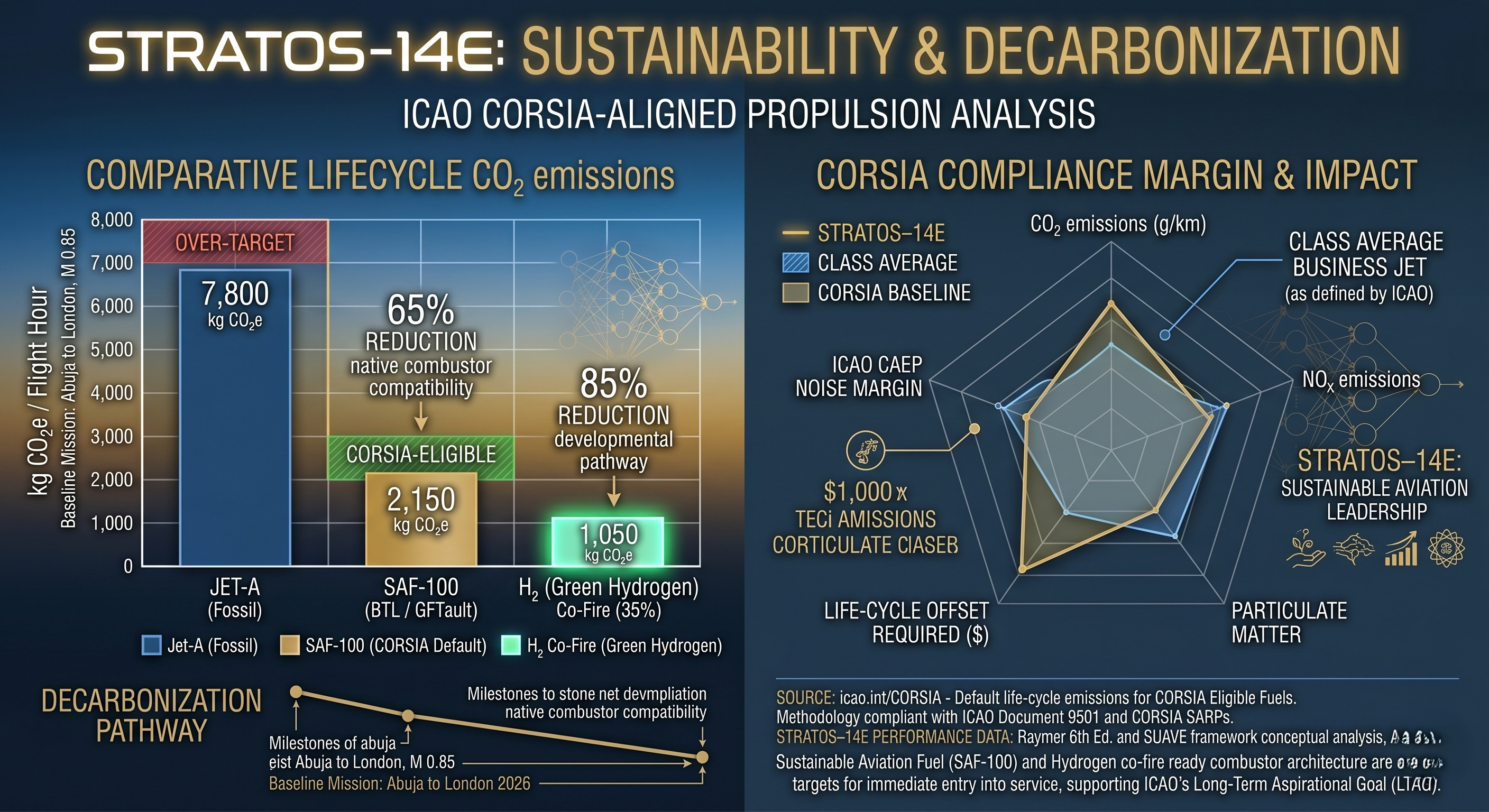
SAF-100 from day one. 65% lifecycle CO₂ reduction. H₂ co-fire ready. Electric ground taxi at 45 km range.
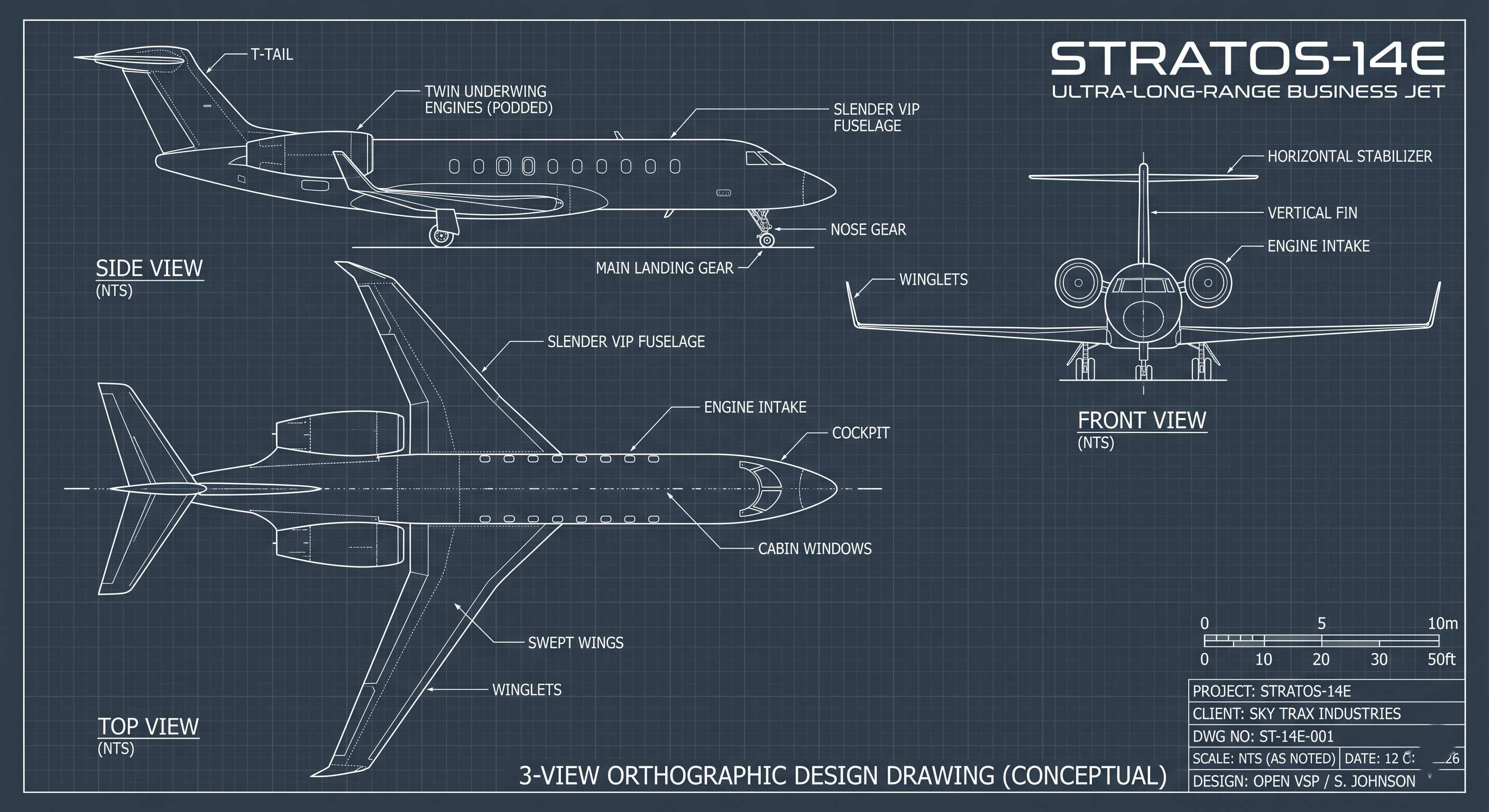
Design & Route Visualization
Sources: 3-view from OpenVSP (NASA); route arcs from Great Circle Mapper (gcmap.com).
Performance Data
All values from AFIT conceptual design analysis, April 2026. Raymer 6th Ed. methodology, OpenVSP geometry, SUAVE performance framework.
PHI-SENSE · The Core Differentiator
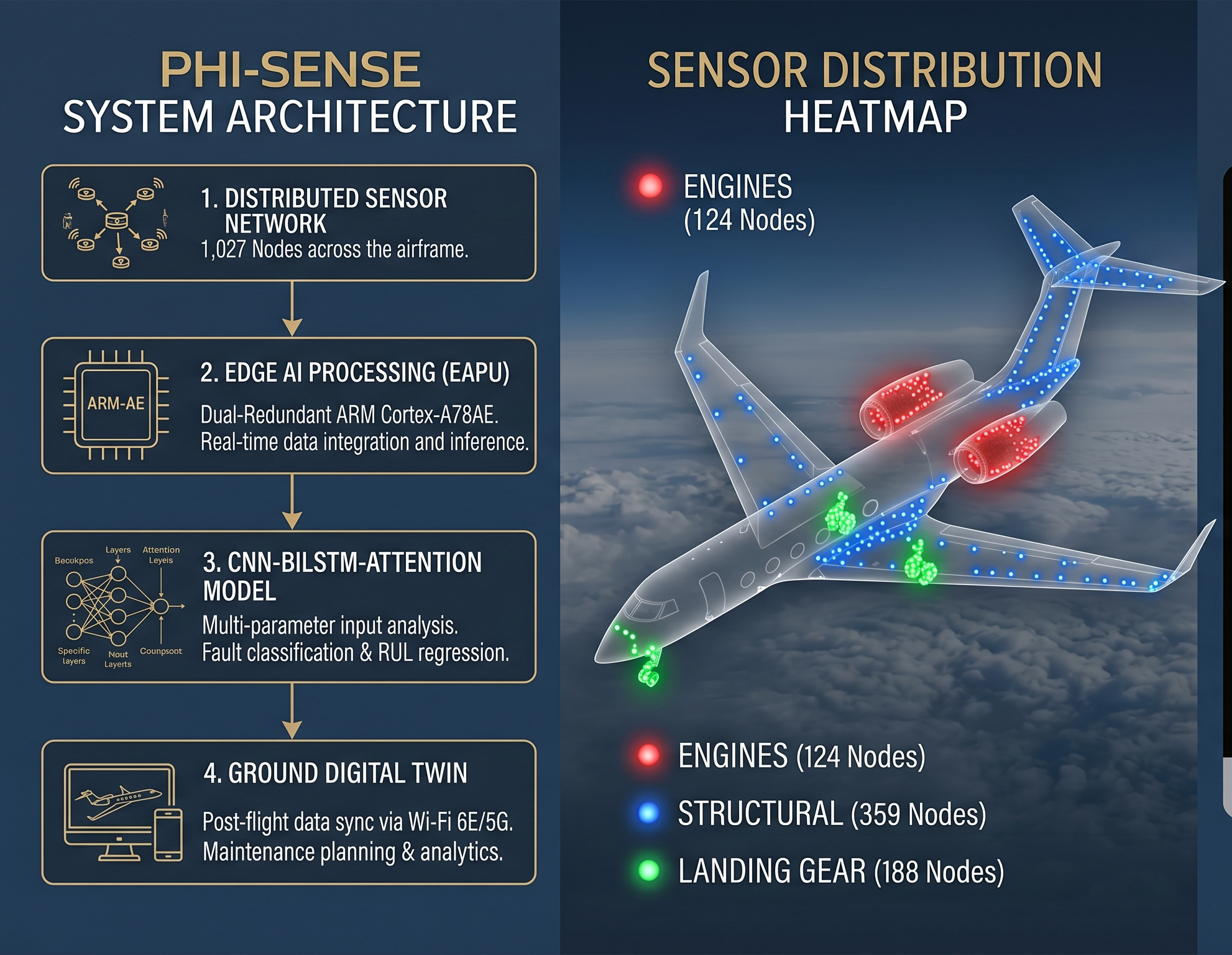
Every aircraft in this class has health monitoring. No aircraft in this class was designed around it. PHI-SENSE is not an add-on box. It is a four-layer physics-informed architecture sized and embedded at the conceptual design stage — sensors woven into the CFRP laminate at layup, not bolted on after certification.
The result: a CNN-BiLSTM-Attention neural network classifying 11 fault domains simultaneously at under 47 ms latency, with a blockchain-secured maintenance ledger that satisfies NCAA and ICAO Doc 9760 continuing airworthiness requirements out of the box.
Competitors offer partial HUMS. PHI-SENSE is full-stack, physics-informed, AI-native health intelligence — the difference between knowing a fault occurred and predicting it 200 flight hours in advance.
Intelligence Infrastructure
4-layer architecture flow diagram (draw.io or Figma).
Sensor heatmap created with Matplotlib / PowerPoint; live PHI-Suite dashboard from Hetzner CX32 deployment.
Competitive Analysis
Performance · Intelligence · Cost Efficiency · Sustainability — simultaneously.
| Aircraft | Range (km) | Seats (max) | Cruise Alt | Cabin Alt | Full HUMS/AI | SAF-100 | BFL | Unit Price (est.) |
|---|---|---|---|---|---|---|---|---|
| Gulfstream G700 | 13,890 km | 19 | 51,000 ft | 4,850 ft | Partial | No | ~1,890 m | ~$78M |
| Bombardier Global 7500 | 14,260 km | 19 | 51,000 ft | 6,000 ft | Partial | No | ~1,768 m | ~$73M |
| Dassault Falcon 10X | 13,890 km | 16 | 51,000 ft | 6,000 ft | Partial | No | ~1,829 m | ~$120M |
| STRATOS–14E ✦ | 12,500 km | 14 VIP | 51,000 ft | 4,500 ft | Full AI-PHM | Yes (native) | 1,640 m | $64M |
Environmentally Benign Propulsion
While competitors retrofit sustainability around existing engine designs, the STRATOS–14E selected a propulsion architecture with SAF-100 and hydrogen co-firing native to the combustor geometry — not a blend workaround.
The eGround electric taxi system eliminates main-engine operation during all surface movement, removing 93% of apron particulate emissions and saving 150–250 kg fuel per flight in taxi fuel alone.
CO₂ lifecycle comparison (Jet‑A vs SAF‑100 vs H₂). Source: ICAO CORSIA
Operational Efficiency · MRO Impact
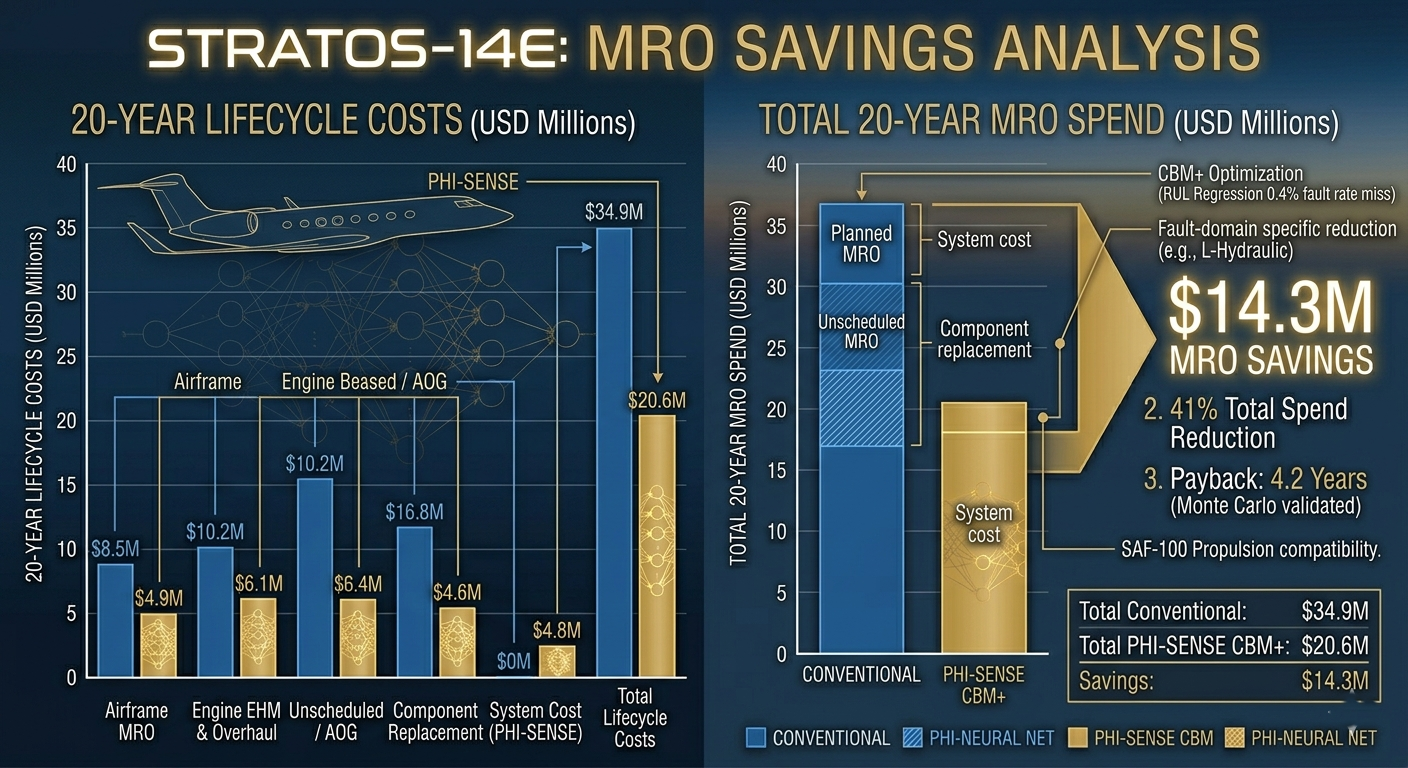
PHI-SENSE's additional system cost of approximately $4.8M per aircraft achieves full financial payback in 4.2 years through maintenance cost avoidance alone — independent of the operational availability improvement.
| Metric | Conventional | PHI-SENSE CBM+ | Improvement |
|---|---|---|---|
| Unscheduled AOG events / yr | 8.2 | 4.8 | −41.5% |
| Maintenance man-hours / 1,000 flt hr | 142 | 98 | −31.0% |
| Component replacement cost / yr | $1.20M | $0.72M | −40.0% |
| Engine TBO (condition-based) | 5,000 hr | 8,000 hr | +60.0% |
| Mean Time Between Maint. Events | 180 hr | 290 hr | +61.1% |
| Aircraft availability improvement | baseline | +31% | +31.0% |
Conventional vs PHI-SENSE CBM+ cost comparison.
Cabin Experience
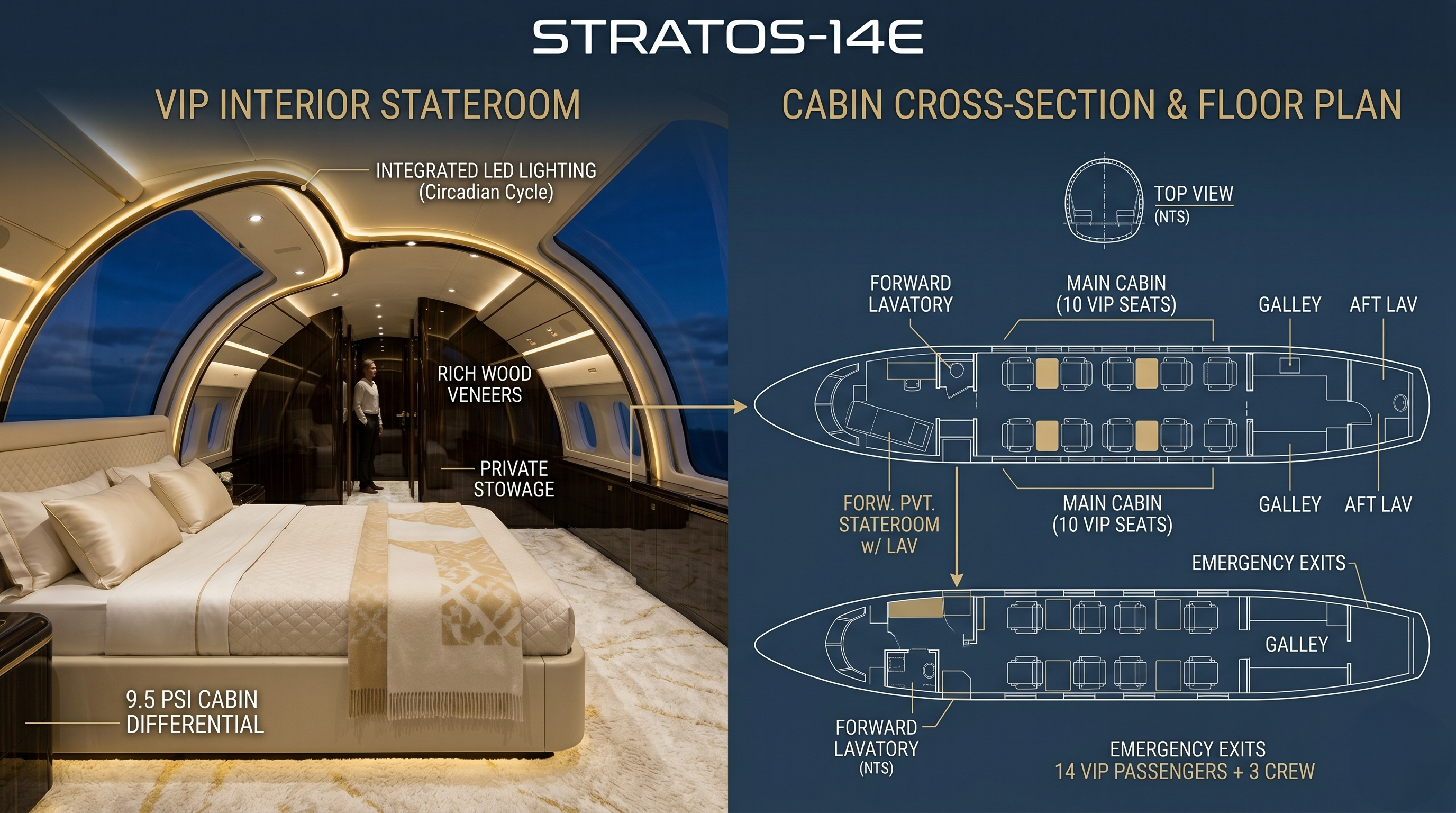
4,500 ft equivalent cabin altitude at 51,000 ft — the lowest in its class. 2.44 m internal width. 1.88 m stand-up headroom. 14.8 m usable cabin length.
Interior concept render; floor plan per STRATOS-14E proposal Section 3.2.
4.2 m exclusive zone with lie-flat berthing, private work surface, and forward lavatory. Full privacy separation from main cabin.
42% lower equivalent altitude than competitors at FL510. Measurably reduces passenger fatigue on intercontinental flights, with a pressure differential of 9.5 psi — highest in class.
T-tail aft-engine configuration reduces cabin interior noise by over 6 dB(A) versus underwing-engine competitors. Multi-layer CFRP fuselage with acoustic foam lining.
Independent HVAC zones per cabin section. Humidity regulation. HEPA-grade air filtration. Adaptive LED circadian lighting that synchronises with time-zone transitions.
4 club seats (2-2 side-by-side) plus 10 individual VIP seats — all with full recline, personal IFE, and oversize table surfaces. Total: 14 passengers + 3 crew.
Split-payload rotating Ghost ID architecture secures all aircraft communications. Maintenance events are Ed25519 cryptographically signed — immutable airworthiness trail accessible to NCAA regulators on demand.
Financial Analysis
At $64M list price — $9M below the Bombardier Global 7500 and $14M below the Gulfstream G700 — the STRATOS–14E enters service with an immediate acquisition cost advantage.
The direct operating cost of $4,870/flight hour compares favourably against the $5,400–6,200/hr range of primary competitors when fuel efficiency, reduced maintenance spend, and PHI-SENSE cost avoidance are accounted for.
Over a 20-year, 800 hr/year operational lifecycle, the total estimated lifecycle savings versus class average is $34.9M.
Direct Operating Cost (DOC) — 800 hr/yr
Market Positioning
The STRATOS–14E fills a critical gap. Existing ultra-long-range business jets were engineered for established Western infrastructure — long, well-maintained runways, dense maintenance networks, and cool operating temperatures.
Nigeria alone has 36 state governments and a Federal Capital Territory. Sub-Saharan Africa has over 50 sovereign nations. The Gulf has 6 wealthy states operating sovereign fleets. None have a purpose-built transport designed to their operating reality.
Until now.
Mission Reach from Abuja